
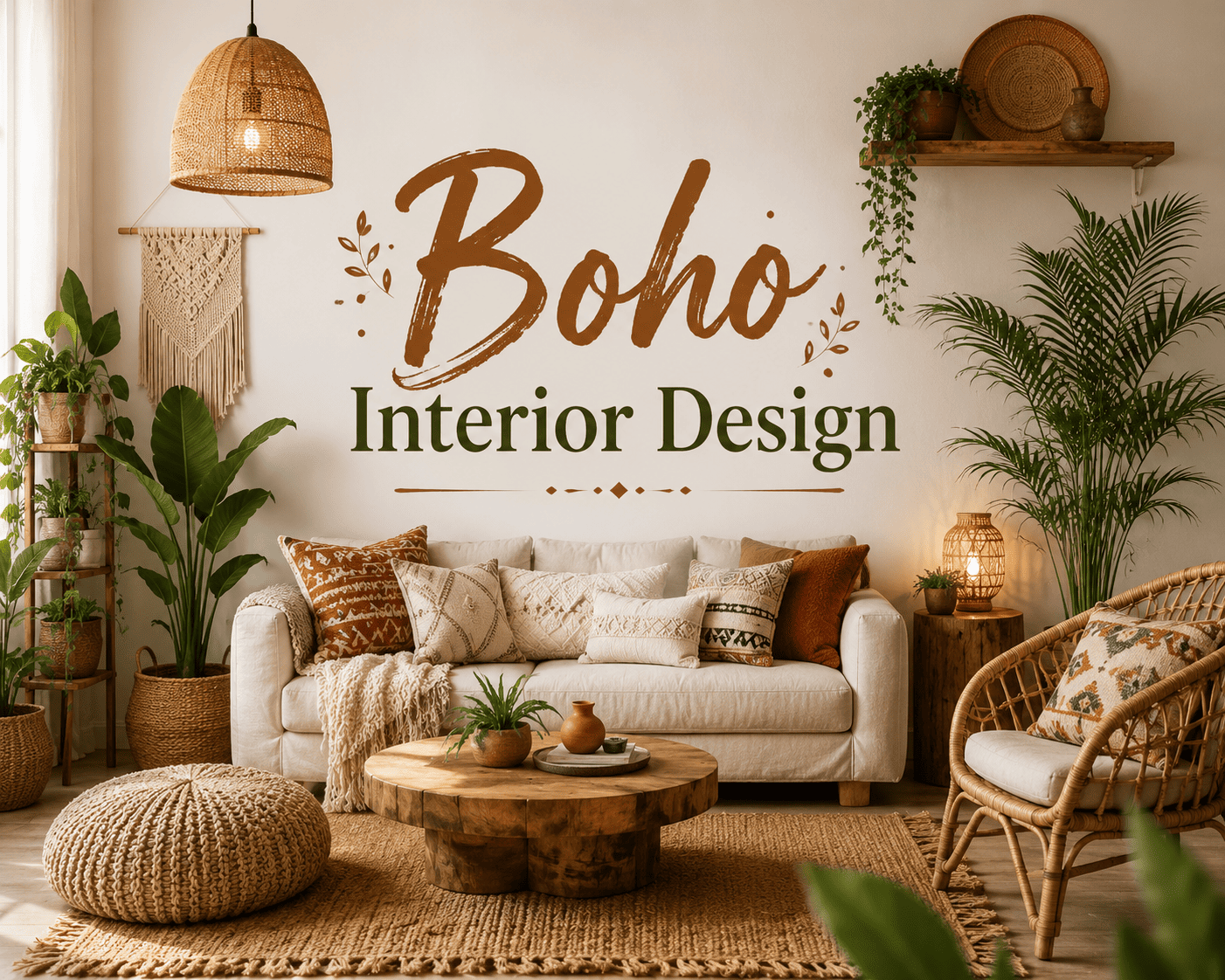
Boho interior design is a relaxed, eclectic decorating style that combines natural materials, layered textures, earthy colors, vintage or collected pieces, plants, and artistic details. Rather than relying on matching furniture or strict symmetry, it creates a personal atmosphere through contrast, texture, imperfection, and carefully layered objects.
Introduction
Boho interior design has evolved far beyond the predictable combination of rattan furniture, macramé, and overflowing houseplants. The most compelling boho homes today feel warmer, more sophisticated, and much more personal. They mix old and new, rough and refined, quiet neutrals and unexpected color, creating rooms that look collected rather than decorated from a single shopping list.
That is what makes boho interiors so appealing. There is no requirement for perfectly matching furniture or flawless symmetry. In fact, a little imperfection is part of the charm. A vintage cabinet can sit beside a streamlined sofa. A dramatic artwork can share a wall with a woven textile. A modern lamp can illuminate an antique-looking table.
The trick is making those contrasts feel intentional.
In this guide, you’ll discover 20 boho interior design ideas that go beyond the usual decorating advice. Each idea focuses on a specific design move you can actually use, whether you’re refreshing a cozy living room, creating a relaxed bedroom, decorating a small apartment, or giving your entire home a more expressive personality.
20 Wildly Chic Boho Interior Design Ideas
1. Mix Furniture From Different Eras
One of the fastest ways to make a room feel genuinely bohemian is to stop buying furniture that looks like it came from the same collection.
Pair a contemporary sofa with a vintage wooden cabinet. Place a mid-century chair beside a rustic coffee table. Mix streamlined furniture with pieces that have visible grain, aged finishes, or handcrafted details.
The goal isn’t random mismatching. Choose pieces that share something—perhaps a wood tone, fabric texture, or color—while allowing their silhouettes and eras to differ. That small connection keeps an eclectic room visually coherent.
2. Layer Rugs Instead of Stopping at One
A single rug can define a room, but layered rugs create the depth that makes boho interiors feel relaxed and collected.
Try placing a smaller patterned rug over a larger neutral jute or flatweave rug. The bottom layer establishes texture and warmth while the top layer introduces color or pattern.
Keep the relationship intentional. If both rugs have loud patterns, the floor can become visually overwhelming. Let one provide the personality while the other acts as a quiet foundation.
3. Let Earthy Colors Become Richer and Moodier
Boho interiors don’t have to live in a sea of beige. Modern bohemian spaces often become much more sophisticated when earthy neutrals are paired with deeper shades.
Think terracotta, olive green, rust, camel, warm cream, tobacco brown, clay, and chocolate. For a dramatic accent, introduce burgundy, forest green, charcoal, or muted ochre.
A useful approach is to keep the largest surfaces relatively grounded and introduce stronger colors through artwork, cushions, rugs, curtains, or smaller furniture pieces. This gives the room depth without making the palette feel chaotic.
4. Make Natural Texture the Star
Color attracts attention, but texture is what makes a boho room feel rich.
Layer linen curtains with a woven rug. Combine rattan or cane with raw wood. Add leather beside soft cotton, chunky knits beside smooth ceramics, and handmade pottery beside polished surfaces.
The contrast matters. A room filled entirely with rough natural materials can feel flat despite having plenty of texture. Mixing tactile surfaces with smoother finishes creates a more sophisticated sensory balance.
5. Turn Your Walls Into a Personal Art Story
Instead of treating wall decor as an afterthought, make it one of the strongest expressions of the room.
Combine artwork, photography, mirrors, woven wall pieces, vintage textiles, sketches, or ceramic plates. The collection doesn’t need to look perfectly symmetrical. It should feel as though the pieces were discovered gradually.
To prevent a gallery wall from becoming visually messy, repeat one or two colors across several pieces. That subtle repetition creates unity while allowing the artwork itself to remain eclectic.
6. Choose One Statement Piece That Breaks the Formula
A room becomes memorable when it contains something unexpected.
It could be an oversized sculptural chair, a dramatic pendant, a huge piece of abstract art, an unusually shaped mirror, or a vintage cabinet in a surprising color.
The key is restraint. One strong statement piece can give the entire room direction. Five competing statement pieces simply create noise.
Let the unusual item be the star, then use quieter furniture and accessories to support it.
7. Create a Plant Corner Instead of Scattering Greenery Everywhere
Plants are closely associated with bohemian interiors, but simply placing a plant on every available surface can make a room feel predictable.
Instead, create one intentional plant composition.
Combine a tall floor plant with a trailing variety and a smaller plant in a ceramic or terracotta planter. Vary the heights so the arrangement moves upward and downward rather than forming a flat row.
Woven baskets, aged terracotta, and handmade ceramic pots can reinforce the natural character without turning the room into a greenhouse.
8. Mix Patterns With a Simple Visual System
Boho style welcomes pattern, but successful pattern mixing isn’t completely random.
Start with one dominant pattern, such as a large floral or geometric design. Add a smaller secondary pattern and finish with a subtle accent print. Keep at least one color common between them.
You can use this technique across rugs, cushions, curtains, throws, and artwork. The patterns can be different, but the repeated color creates a visual bridge.
This is how to achieve an eclectic look without crossing the line into visual clutter.
9. Forget the Single Overhead Light
Lighting can completely change the character of a boho interior.
Instead of relying on one ceiling fixture, create layers at different heights. Use a floor lamp near seating, a table lamp on a console, a pendant over the dining table, and small sources of ambient light around the room.
Warm-toned lighting works particularly well with wood, linen, woven materials, and earthy colors because it enhances their natural warmth.
The result should feel atmospheric rather than brightly illuminated from one central point.
10. Style the Coffee Table Like Someone Actually Lives There
The best boho coffee tables don’t look like showroom displays.
Start with a tray or stack of books to establish structure. Add a handmade bowl, small vase, candle, or natural object. Then introduce one unusual item with personality.
Avoid arranging everything into perfect pairs. A slightly asymmetrical composition usually feels more relaxed and authentic.
Most importantly, leave some empty surface. A coffee table needs to remain functional, not become a miniature museum.
11. Make the Bedroom Feel Like a Collected Escape
Boho bedrooms work best when comfort takes priority over perfection.
Layer linen or cotton bedding with a textured quilt, knitted throw, or casually folded blanket. Add a wooden nightstand, woven basket, vintage-style mirror, or piece of expressive artwork.
Instead of matching every element, create connections through texture and color. A warm wood finish can repeat through the bed frame and nightstand while the textiles provide variation.
Soft, layered lighting will complete the atmosphere and make the room feel relaxed rather than overly styled.
12. Let the Living Room Look Lived-In
A boho living room should invite people to sit down.
Choose comfortable seating with relaxed silhouettes and combine it with natural materials, textured cushions, throws, rugs, and personal objects. A floor cushion or low stool can add another informal seating option.
Don’t hide every sign of everyday life. Books, collected objects, artwork, travel-inspired pieces, and imperfectly arranged textiles can make the room feel authentic.
The objective is not messiness. It’s creating a space that looks comfortable enough to actually use.
13. Break Up a Sleek Kitchen With Boho Warmth
Kitchens can easily feel dominated by hard surfaces, straight lines, and uniform cabinetry. Natural materials can soften that effect.
Use open shelving for handmade ceramics, wooden cutting boards, woven baskets, or carefully selected cookware. Add greenery where practical and introduce warm wood or aged finishes to counterbalance glossy surfaces.
The important distinction is curation. Open shelves should not become storage for everything you own. Display useful objects that also contribute to the room’s visual character.
14. Stop Matching Every Dining Chair
A dining area can become instantly more interesting when you abandon the idea that every chair needs to be identical.
Try combining a wooden bench with different chair styles, or use chairs with similar shapes in slightly different finishes. Pair the seating with an organic wood table and a sculptural pendant.
The table should remain the visual anchor. The mismatched seating adds personality without making the dining room feel disorganized.
15. Make a Small Space Feel Layered, Not Crowded
Boho style can work beautifully in a small apartment, but excessive decoration can quickly make the space feel smaller.
Use vertical space with tall shelving or hanging plants. Choose furniture that serves more than one purpose, and use mirrors strategically to reflect light and create depth.
Rather than decorating every corner, choose two or three areas to emphasize. A textured seating zone, an interesting wall, and a plant-filled corner may be enough.
Small spaces benefit from edited boho styling: fewer objects, stronger choices.
16. Bring in Vintage Pieces With a Story
Nothing gives a boho interior character quite like something that looks as though it has lived another life.
Look for vintage furniture, old frames, woven textiles, aged wood, secondhand ceramics, or decorative objects with visible craftsmanship.
You don’t need an entire antique collection. One vintage cabinet or weathered wooden stool can provide enough contrast to prevent a modern room from feeling generic.
The secret is allowing the older piece to retain some of its character rather than trying to make it look brand new.
17. Try Dark Boho for a More Dramatic Interior
If traditional boho feels too light or casual, dark boho offers a richer alternative.
Deep olive, charcoal, chocolate brown, muted burgundy, and other earthy dark shades can create an intimate backdrop for natural textures. Add dark wood, aged metal, linen, leather, and warm lighting to build depth.
Because darker colors absorb light, balance them with tactile materials and several warm light sources. The result can feel sophisticated and atmospheric rather than heavy.
18. Stop Pairing Everything Perfectly
Perfect symmetry has its place, but boho interiors often become more interesting when things are deliberately a little off.
Instead of two identical bedside tables, use complementary pieces. Hang artwork at slightly different heights. Combine different lamps or chairs that share a common color or material.
The goal isn’t to create disorder. It’s to create visual movement.
A useful rule is to balance weight, not necessarily symmetry. If one side of a room feels visually heavy, counter it with another strong shape or texture elsewhere.
19. Leave Some Space Completely Empty
This may be the most important rule-breaking idea of all: you don’t have to decorate every inch of the room.
Negative space gives layered interiors room to breathe. An empty section of wall can make a nearby artwork more noticeable. A clear stretch of floor can make a textured rug feel more intentional.
Boho does not mean maximum objects. It means meaningful layers.
When every surface is occupied, even beautiful pieces lose their impact. Editing is what transforms an eclectic collection into sophisticated boho interior design.
20. Add One Thing That Shouldn’t Work—But Does
The most memorable boho rooms usually contain one element that challenges expectations.
Maybe it’s a bright cobalt chair inside an earthy room. Perhaps it’s a modern sculpture beside antique furniture, an oversized contemporary painting above a rustic cabinet, or a playful pattern in an otherwise restrained space.
This unexpected element gives the room personality.
Don’t ask whether every piece belongs to the same style. Ask whether the combination creates an interesting conversation. That shift in thinking is at the heart of modern boho decor.
How to Make Boho Interior Design Look Chic, Not Cluttered
Keep the Color Palette Under Control
Boho interiors can handle plenty of color, but they still need visual structure. Choose a dominant base, a secondary earthy shade, and one or two stronger accents.
This allows patterns and accessories to vary without making the entire room feel disconnected.
Repeat Materials Without Matching Everything
Repeating natural materials creates cohesion. If you have a wooden coffee table, echo that warmth through a picture frame or side table. If you use rattan furniture, repeat woven texture through a basket or pendant.
The pieces don’t need to match. They simply need to relate.
Give Every Room a Visual Focal Point
A strong focal point prevents eclectic rooms from becoming overwhelming. It might be a dramatic bed, fireplace, artwork, pendant, sofa, or vintage cabinet.
Once the focal point is established, let the surrounding pieces support it instead of competing with it.
Edit Before You Add More
This is where sophisticated boho differs from cluttered boho.
Step back from the room and remove anything that feels repetitive, meaningless, or visually distracting. Rotate accessories instead of displaying everything simultaneously.
The goal is a room full of personality, not a room full of objects.
Modern Boho vs. Traditional Boho: What’s Changed?
Traditional boho interiors were often defined by recognizable elements such as macramé, rattan, layered textiles, abundant plants, and highly patterned fabrics.
Modern boho keeps those natural and relaxed qualities but is less dependent on a specific formula. It freely borrows from mid-century modern, Scandinavian, vintage, rustic, and contemporary interiors.
The biggest change is restraint.
Instead of decorating every surface with bohemian accessories, modern boho relies more heavily on material quality, contrast, negative space, sculptural forms, and carefully selected vintage pieces.
That makes the style feel more sophisticated while preserving its relaxed personality.
Boho Interior Design Mistakes to Avoid
Overdecorating every surface can make a room feel chaotic instead of collected. Give your strongest pieces enough empty space around them to be noticed.
Using too many unrelated patterns can overwhelm the eye. Connect patterns through repeated colors, similar scales, or shared visual qualities.
Relying entirely on beige can make boho interiors look flat. Introduce earthy greens, rust, terracotta, brown, or deeper accent shades for dimension.
Making everything look deliberately bohemian can create a themed-room effect. Mix boho elements with contemporary and vintage pieces instead.
Ignoring lighting can flatten beautiful textures and colors. Use multiple warm light sources to create depth.
Confusing maximalism with clutter is another common mistake. Maximalism still requires editing, hierarchy, and intentional composition.
FAQs
What is boho interior design?
Boho interior design is an eclectic style that combines natural materials, layered textures, earthy colors, vintage pieces, artistic accents, plants, and relaxed furniture. Its defining quality is a collected, personal atmosphere rather than perfect coordination.
What colors work best in a boho interior?
Popular boho colors include cream, terracotta, rust, camel, olive, warm brown, ochre, and chocolate. Deeper shades such as forest green, burgundy, and charcoal can create a more dramatic modern boho look.
How do I make my home look boho without clutter?
Start with a restrained color palette, layer different textures, introduce a few vintage or handmade pieces, and leave intentional negative space. Choose fewer meaningful accessories rather than filling every shelf and surface.
Conclusion
Combine boho staples such as woven materials, earthy colors, plants, and textiles with cleaner furniture silhouettes, contemporary artwork, sophisticated lighting, and intentional negative space. The contrast keeps the room current rather than overly themed.
The best boho interiors aren’t created by following a shopping checklist. They’re created by understanding how contrast, texture, color, scale, and personality work together.
Mix furniture from different eras. Layer rugs. Let earthy colors become richer. Bring in vintage pieces. Break symmetry. Create breathing room. Most importantly, give yourself permission to include something unexpected.
That is the real appeal of boho interior design: it doesn’t ask your home to look perfect. It asks your space to look interesting, personal, comfortable, and unmistakably yours.

Leave a Reply