
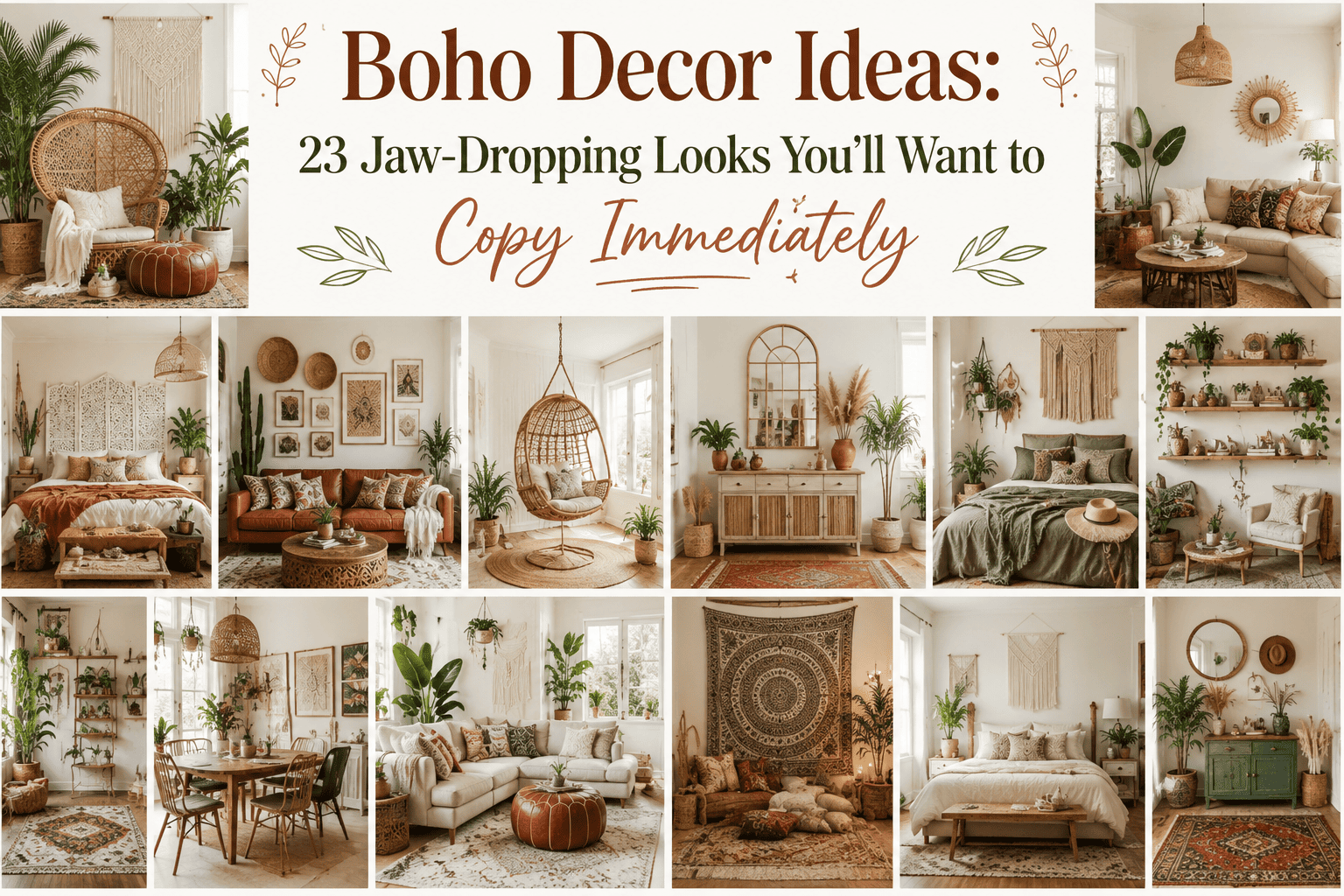
Combine natural materials — wood, rattan, linen, jute, ceramic — with earthy tones, relaxed furniture, and layered textiles, then add one or two artistic statement pieces. Keep the palette tight, let texture do the heavy lifting instead of extra accessories, and introduce a single unexpected element for personality. Done well, the room reads as warm, collected, and effortless — never overly themed.
Introduction
Boho decor ideas have moved on from macramé walls, overflowing plant shelves, and rooms stacked with patterned cushions. Modern boho decor now leans warmer, more curated, and far more intentional — built on natural materials, earthy color palettes, relaxed furniture silhouettes, layered textiles, and a handful of artistic details that feel collected rather than assembled overnight.
The style lives on balance. A great bohemian interior stays relaxed without looking messy, colorful without tipping into chaos, and eclectic without losing its sense of direction. Instead of filling every empty corner, modern boho gives its best pieces room to actually be seen.
Whether you’re reworking a boho living room, freshening up a bedroom, or simply layering bohemian touches into a neutral home, these 23 ideas will help you build a space with real warmth, character, and personality — not just a theme.
1. Build Around a Desert-Inspired Palette
A desert palette is the fastest route to a sophisticated boho room. Reach for warm white, sand, caramel, clay, terracotta, muted rust, and soft brown instead of anything bright or primary.
Anchor the space with a neutral wall or sofa, then bring in warmer tones through cushions, rugs, artwork, and ceramics. The effect reads sun-washed and earthy — never a costume-y Southwestern theme.
For a sharper, more contemporary finish, drop in a touch of charcoal or matte black. That single dark note keeps a warm palette from going flat.
2. Let One Oversized Artwork Anchor the Sofa Wall
Skip the gallery of small prints and commit to one large piece instead. An oversized abstract painting, a desert landscape, a textured canvas, or an earthy photographic print instantly makes a living room feel deliberate.
For proportion, aim for artwork roughly two-thirds to three-quarters the width of the sofa, centered above the seating rather than pushed to one side.
The finishing touch: pull one or two colors from the artwork into the rest of the room. That small thread of repetition makes the piece feel built-in, not bolted on.
3. Turn the Fireplace Into a Boho Focal Point
A fireplace already carries architectural weight, so resist the urge to crowd it. Style the mantel with a few objects of varying height and texture — a handmade ceramic vase, a sculptural form, a small artwork, a softly glowing candle.
Natural wood, stone, plaster, and aged finishes suit this spot well; they add depth without tipping the fireplace into overly formal territory.
Leave space between objects. In boho design, the empty space around a piece matters as much as the piece itself.
4. Lean Into a Sun-Drenched Boho Look
If a room gets good natural light, build the decor around it rather than against it. Sheer curtains, warm white walls, pale wood, linen upholstery, and soft beige textiles create a relaxed, light-filled atmosphere.
Skip heavy window treatments that block the brightness; woven shades or lightweight curtains handle privacy without dimming the room.
This look is especially effective in bedrooms and living rooms, where soft fabric and daylight do most of the work — no extra decoration required.
5. Pair Curved Furniture With Raw Textures
Modern boho gets interesting where polished shapes meet imperfect natural materials. Set a curved sofa or rounded accent chair against a chunky wood table, a woven basket, a stone object, or a heavily textured rug.
That contrast keeps the room from feeling predictable — curves bring softness, raw materials bring weight and authenticity.
You don’t need every piece to be organic in shape. One curved sofa, mirror, or chair is usually enough to soften a room built on straight lines.
6. Design a Hotel-Inspired Boho Bedroom
Start with the bed. Choose an oversized upholstered, cane, or wooden headboard, then layer bedding in cream, taupe, caramel, or muted earth tones around it.
Add warm bedside lighting instead of relying on an overhead fixture. Linen sheets, a textured throw, and one or two well-chosen cushions bring richness without clutter.
The result should feel like a relaxed boutique hotel room — not a themed bohemian bedroom.
7. Try Dramatic Earth-Tone Color Blocking
Paint alone can transform a room. Try a warm cream wall with a terracotta arch behind a console, bed, or reading chair, or combine two related shades across a single wall for subtle architectural definition.
This works because it creates a focal area without the cost of statement artwork or built-ins.
In a smaller room, keep the stronger shade confined to one section — enough drama, without closing the space in.
8. Make the Bed the Main Event
The bed already dominates a bedroom, so use it. Layer different materials rather than simply piling on more pillows: crisp cotton sheets, a linen duvet, a chunky woven throw, and two or three cushions in complementary tones.
A statement headboard adds another layer of interest on top.
For a more natural finish, skip perfect symmetry on both sides of the bed. A slightly relaxed arrangement reads more genuinely bohemian than a mirrored one.
9. Bring In One Sculptural Statement Chair
A single distinctive chair can shift the feel of an entire room. Look for curved silhouettes, woven cane, bouclé upholstery, natural leather, or an unusual wooden frame.
Give it a place to be seen rather than tucking it into a corner — beside a window, near a bookshelf, or opposite the sofa with a small side table.
One memorable chair typically does more work than several ordinary decorative pieces combined.
10. Style a Boho-Inspired Gallery Shelf
Open shelving can tell a story when it’s styled with restraint. Mix leaning artwork with handmade ceramics, books, small sculptures, candles, and a natural element or two.
Vary the heights so the arrangement doesn’t read as a row of identical objects, and leave gaps between groupings for breathing room.
Personal, unmatched objects matter most here — boho decor should feel lived-in, not showroom-copied.
11. Give the Entryway a Boutique-Hotel Feel
The entryway sets the tone for everything that follows. A slim wooden console, an oversized organic mirror, a textured runner, and a warm lamp are enough to make a strong boho statement.
Keep the console surface relatively clear — one sculptural vase, a small tray, or a stack of books is plenty.
In a narrow entryway, prioritize height: a tall mirror or wall-mounted artwork draws the eye upward without eating into floor space.
12. Add Black Accents for Modern Contrast
Earthy palettes can drift too soft without something to sharpen them. A few black accents give modern boho interiors a defined edge.
A black picture frame, a dark lamp base, a charcoal cushion, black hardware, or a slim metal side table all work — the goal is contrast, not domination.
Repeat black in two or three spots and it starts to create visual rhythm, tying the room together rather than standing out as one odd accent.
13. Layer the Window Treatment
Windows are easy to overlook, but layering sheer curtains with woven shades adds softness, privacy, and texture all at once.
Choose curtains in ivory, oatmeal, or warm beige, and pair them with bamboo or woven shades. Hang the curtains slightly wider and higher than the frame to make the window read larger than it is.
This simple move suits modern boho particularly well — it adds texture without introducing another bold pattern.
14. Choose a Handmade-Looking Statement Table
Furniture doesn’t need to be perfectly symmetrical to feel sophisticated. A chunky wooden coffee table, an irregular-edge side table, or a stone-inspired piece can anchor a boho living room on its own.
Look for visible grain, subtle imperfections, and tactile finishes — these are the details that make a piece feel authentic rather than mass-produced.
Style it lightly. If the table already has a strong shape, a single ceramic vessel or a stack of books is all it needs.
15. Turn the Dining Area Into an Artistic Corner
A dining area can carry as much personality as a living room. Start with a solid wood table, then bring in chairs with slightly different textures or silhouettes rather than a matched set.
Hang a sculptural pendant above the table for a warm pool of light, and finish with a low ceramic centerpiece that doesn’t block sightlines across the table.
Wood, mixed seating, warm lighting, and handmade accessories together create an inviting dining space that never feels over-styled.
16. Hang Textiles as Wall Art
Textiles bring softness and dimension that framed prints can’t match. A woven tapestry, vintage rug, embroidered fabric, or handmade textile panel works as artwork while adding tactile interest to a wall.
This is especially effective behind a bed or across a large, empty living room wall.
Pick a piece that already shares colors with the room — that connection is what makes it feel integrated rather than randomly hung.
17. Build a Moody Boho Corner
Boho doesn’t have to stay light and beige. Deep brown, muted burgundy, olive, smoked amber, and warm charcoal create a richer, more intimate take on the style.
Reserve these darker tones for a single reading nook, bedroom corner, or lounge area rather than the whole home.
Low-level lighting is non-negotiable here — a floor lamp, table lamp, or warm wall sconce will build far more atmosphere than an overhead fixture ever could.
18. Bring Boho Warmth Into the Kitchen Without Renovating
A full kitchen makeover isn’t necessary. Swap overly uniform accessories for natural wood boards, handmade ceramics, woven baskets, linen towels, and warm-toned containers.
On open shelving, mix everyday kitchenware with a few decorative pieces, keeping what you actually use within easy reach and saving the more decorative items for less crowded shelves.
The kitchen ends up feeling relaxed and personal — without losing an inch of function.
19. Let Your Decor Tell a Travel Story
Bohemian style has always had ties to travel and discovery, which makes this one of its most personal ideas. Rather than buying accessories in bulk, display a handful of objects that actually mean something.
A vintage map, a handmade bowl, a travel photograph, a carved object, or an artisan textile all work well.
Set these alongside modern furniture so the room reads as collected over time — not artificially themed around a single trip.
20. Introduce One Unexpected Color
Boho palettes don’t have to stay locked into beige and brown. A single unexpected color can make an earthy room far more memorable.
Try deep emerald with cream, cobalt with terracotta, dusty pink with walnut, or muted mustard with warm white.
Use the bold color sparingly — one chair, one artwork, one cushion, one vase — and repeat it once or twice elsewhere to keep the room cohesive rather than scattered.
21. Design a Minimal Boho Corner
For anyone drawn to the style but wary of clutter, minimal boho is the compromise. One comfortable chair, a small natural-wood table, a textured rug, and a single plant or sculptural object is enough.
The real work here is leaving space — plenty of it — around the arrangement.
Strong silhouettes and tactile materials carry visual interest even with very few objects, proof that boho decor doesn’t require a room full of accessories to feel intentional.
22. Create a Floor-Level Conversation Zone
For relaxed, social seating, bring part of the arrangement down to floor level. Oversized floor cushions, a low coffee table, soft poufs, and a layered rug build an intimate conversation area fast.
This works especially well in larger living rooms, where standard furniture placement often leaves awkward gaps of empty floor.
Choose durable, washable fabrics if the zone will see regular use — comfort should be part of the design from the start, not an afterthought.
23. Close With One Unforgettable “Wow” Piece
The strongest boho rooms almost always have one element that grabs attention first — an oversized mirror, a dramatic pendant, a sculptural chair, a vintage cabinet, an unusual artwork, or a beautifully crafted table.
Keep everything around it quieter. That restraint is what gives the piece its hierarchy and makes it read as intentional rather than accidental.
Think of it as the room’s signature — the one detail people remember after they’ve left.
Modern Boho Color Combinations That Work Beautifully
Cream and caramel build a soft, sun-washed base, with black stepping in for contrast. Terracotta, ivory, and walnut lean into a warmer, Southwestern-inspired mix. Olive, beige, and brass feel earthy but refined, while chocolate brown, sand, and muted blue create something deeper and more contemporary.
The simplest formula: one dominant neutral, one earthy secondary tone, one small accent color. That’s enough to feel expressive without tipping into visual noise.
Boho Decorating Mistakes to Avoid
The biggest mistake is mistaking abundance for personality. Too much macramé, too many plants, patterns, baskets, and decorative objects crowd a room fast.
A close second is leaning on too many unrelated earthy colors at once — pick a controlled palette and repeat the key shades instead of introducing new ones room by room.
And don’t ignore lighting. Even great furniture and accessories fall flat under harsh overhead light. Layer table lamps, floor lamps, pendants, and natural daylight to give the room actual depth.
FAQ
What colors work best for boho interiors?
Warm white, sand, beige, caramel, terracotta, rust, olive, chocolate brown, and muted black form a solid base. From there, a single stronger shade — emerald, cobalt, mustard, or dusty pink — makes an effective, controlled accent.
How do I make boho decor look expensive?
Focus on scale, texture, and restraint. One oversized artwork or sculptural piece usually reads as more sophisticated than a dozen small accessories. Natural materials, warm lighting, a consistent palette, and uncluttered surfaces all push a room toward feeling elevated.
Can boho style work in a small room?
Yes. Light colors, multifunctional furniture, one strong statement piece, and a lighter hand with accessories let a minimal boho approach make a small room feel warm and layered — without ever feeling tight.
Final Thoughts
The best boho decor ideas aren’t about how much you can fit into a room. They’re about letting natural materials, interesting shapes, layered textures, and personal details work together with room to breathe.
Start with one area instead of overhauling everything at once — a new oversized artwork above the sofa, warmer textiles on the bed, a few handmade pieces swapped in for generic ones, or a single statement corner built from scratch.
Give every element a reason to be there, and boho stops being a passing trend. It becomes a home that feels collected, comfortable, artistic, and unmistakably yours.

Leave a Reply