
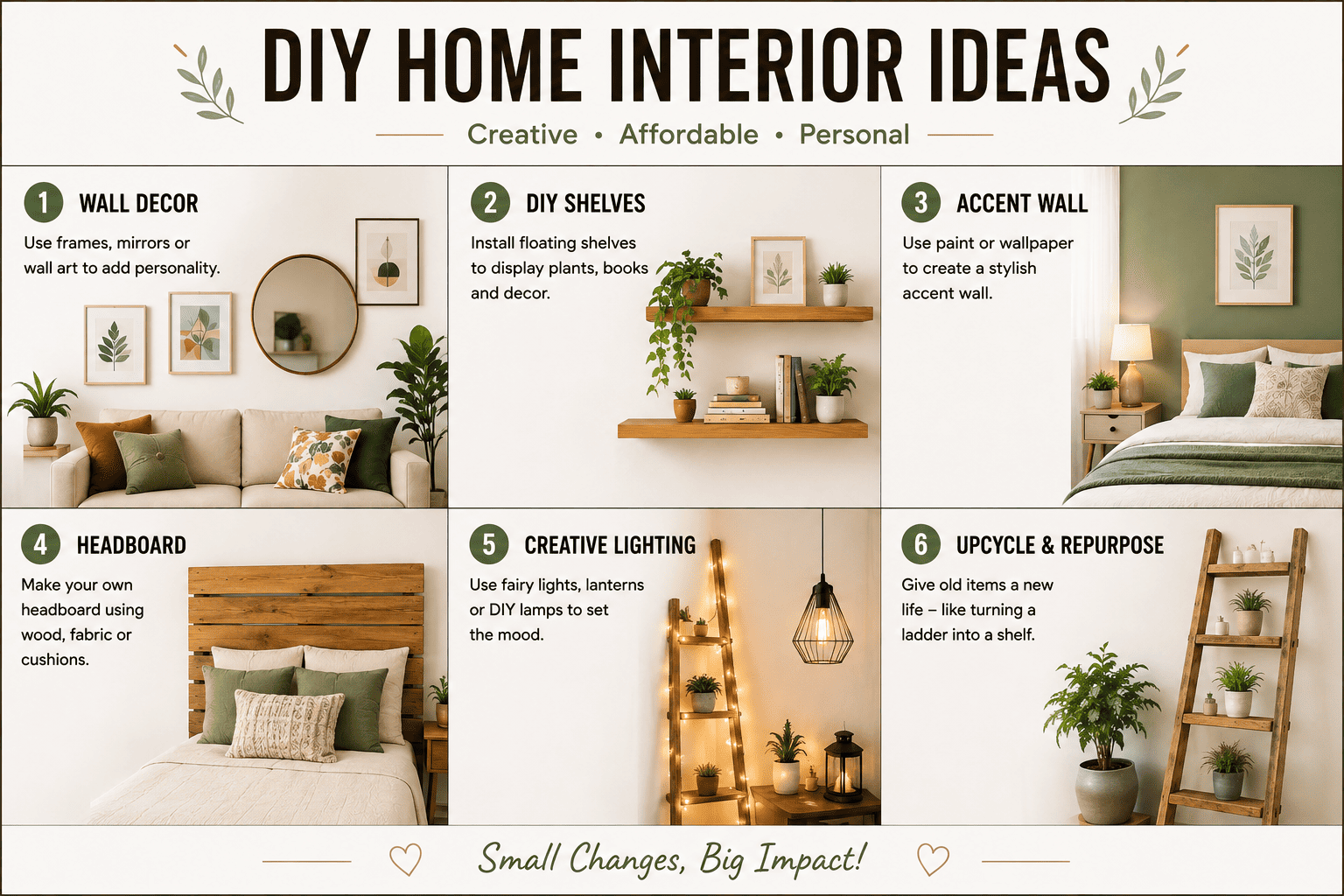
An empty wall can make an otherwise attractive room feel unfinished. Rather than filling it with random decor, turn it into a deliberate focal point.
A painted accent wall is the simplest place to start, but you can add real dimension with picture-frame molding, vertical wood slats, simple paneling, or a painted arch behind a piece of furniture. Choose the wall your eye naturally lands on — behind the sofa, the bed, or the dining table.
For a low-budget update, paint alone is usually enough. For something more architectural, attach thin molding to the wall in evenly spaced rectangles and paint it the same color as the wall itself.
The goal isn’t to make the wall busy — it’s to give an ordinary surface a clear visual job.
Introduction
Take a closer look at your home. The blank wall behind the sofa, the awkward corner by the window, the outdated dresser you stopped noticing years ago, the empty space under the stairs — all of it may be hiding a design opportunity you’ve simply walked past too many times to see.
Great interior design doesn’t always require new furniture, a big budget, or a professional designer. Often, the biggest transformation comes from changing how you use something you already own. A fresh coat of paint, better lighting, upgraded hardware, a strip of trim, or smarter storage can make an ordinary space feel entirely different.
The advantage of DIY design is that you’re working with your existing layout and personality instead of starting from zero. Whether you’re refreshing one room or slowly reworking your whole home, these projects help you build a space that feels intentional, personal, and genuinely finished.
Here are 19 clever transformations that prove your next great decorating idea might already be hiding in plain sight.
1. Turn the Boring Wall Into Your Favorite Wall
An empty wall can make an otherwise attractive room feel unfinished. Rather than filling it with random decor, turn it into a deliberate focal point.
A painted accent wall is the simplest place to start, but you can add real dimension with picture-frame molding, vertical wood slats, simple paneling, or a painted arch behind a piece of furniture. Choose the wall your eye naturally lands on — behind the sofa, the bed, or the dining table.
For a low-budget update, paint alone is usually enough. For something more architectural, attach thin molding to the wall in evenly spaced rectangles and paint it the same color as the wall itself.
The goal isn’t to make the wall busy — it’s to give an ordinary surface a clear visual job.
2. Make an Awkward Corner Look Completely Intentional
That odd corner where nothing quite fits often ends up as overflow storage — bags, boxes, whatever doesn’t have a home elsewhere. Give it one clear purpose instead, and it stops looking like an afterthought.
A small armchair and floor lamp can turn it into a reading nook. A tall plant softens an empty corner with almost no effort. A narrow cabinet adds storage without eating up floor space.
In tighter spots, think vertically — a floating shelf above a compact chair or slim console adds function without crowding the corner.
One rule matters most: don’t ask the corner to do too many jobs at once. A single clear purpose is what makes it read as designed rather than improvised.
3. Make a Basic Dresser Look Custom-Built
Before you replace an old dresser, check whether its shape still earns its keep. Simple silhouettes respond well to paint, trim, and better hardware.
Clean the surface, sand it lightly, repair any obvious dings, prime it properly, and finish with a durable furniture paint. Swapping basic knobs for larger metal, wood, or ceramic pulls changes the whole look almost instantly.
For an even more custom feel, add thin molding to flat drawer fronts — keep the proportions consistent, and paint the entire piece in one unified finish.
This is one of the highest-impact furniture makeovers precisely because the transformation comes from small details, not expensive materials.
4. Give Your Interior Doors a Designer Makeover
Doors get overlooked because we think of them as purely functional. But they occupy more visual real estate than almost anything else in a room.
A flat interior door can be upgraded with simple applied molding, a fresh coat of paint, or new hardware. A deep neutral, a muted green, or a warm brown can make a door stand out without overwhelming the space around it.
Prefer something subtler? Paint the door the same color as the wall, then add decorative paneling — you’ll get architectural interest without a bold color statement.
Whichever route you choose, prep the surface properly before painting, especially over an existing glossy finish. Clean edges and good hardware are what separate a professional-looking result from a rushed one.
5. Fake a Built-In Without Actually Building One
Built-in shelving reads as sophisticated because everything feels connected — and you can recreate that effect with affordable freestanding cabinets and shelves.
Choose pieces with similar depths and heights, then arrange them together as one composition. Trim added around the top and sides hides the gaps and pulls the whole thing into a single, architectural-looking unit.
For the most convincing effect, paint the furniture, the trim, and the surrounding wall in the same or a closely related color, so the individual pieces visually disappear into the wall.
This trick works especially well around a television, a fireplace, a home office setup, or a reading corner — anywhere storage was already needed.
6. Turn a Forgotten Hallway Into a Design Moment
Hallways rarely hold much furniture, but that doesn’t mean they should feel empty. Because they connect the rest of the home, even a small styling change here makes the whole house feel more considered.
Try a narrow picture ledge with rotating artwork, a large mirror, or a run of similarly sized frames. If the hallway is dim, fix the lighting before you add more decor — no amount of styling compensates for poor light.
A slim console works well in a wider hallway; a wall-mounted shelf suits a narrow one.
Keep the walking path clear. The best hallway decor adds personality without getting in anyone’s way.
7. Make a Basic Mirror Look Like a Luxury Find
A plain mirror becomes a genuine design feature with the right frame. Wood trim gives it a warm, architectural feel; a thick painted frame adds substance; a textured plaster-style finish adds a softer, handcrafted quality.
Placement matters as much as the frame itself. Position the mirror so it reflects daylight, a window, artwork, or another attractive part of the room — that’s what adds visual depth, rather than simply hanging a reflective surface on an empty wall.
In small rooms and narrow entryways, an oversized mirror is especially effective, since it visibly opens up the space.
8. Steal the Space Inside an Unused Closet
An underused closet is valuable square footage in disguise. Depending on its size and location, it can become a compact home office, a vanity area, a coffee station, a linen zone, or a craft corner.
Clear it out first, measure the interior, and only then shop for shelves or furniture that actually fit. A floating shelf or narrow desk makes the most of limited floor space, and a small light fixture solves the lighting problem most closets have. Matching storage containers keep the finished space looking calm rather than cluttered.
This transformation works because you’re not adding a room — you’re giving forgotten space a job.
9. Make Builder-Grade Cabinets Look High-End
Plain cabinets don’t necessarily need replacing — hardware alone can change their entire character. Swap dated knobs and pulls for something that complements the room’s other metal finishes. If the cabinet fronts are flat, narrow trim can add a paneled, custom look, and under-cabinet lighting improves both function and atmosphere.
In kitchens especially, resist the urge to fill the counter back up after the upgrade. A single cutting board, a ceramic vessel, or one well-placed plant will have more impact than a row of small accessories.
The best cabinet makeovers pair appearance with everyday practicality — they should look better and work better.
10. Look Up: Your Ceiling Is the Fifth Wall
Most decorating stops at eye level, leaving the ceiling completely untouched — which makes it one of the most overlooked opportunities in the whole house.
A soft ceiling color can make a room feel warmer and more enclosed. Decorative molding adds architectural definition, and simple wood detailing brings texture overhead. In a small room, keep the treatment light unless you specifically want drama; in a larger room, a bolder ceiling can become the room’s real focal point.
Before starting, factor in ceiling height, natural light, and furniture scale — the goal is a ceiling that supports the room, not one that competes with it.
11. Create a Statement Headboard Without Buying One
A bedroom can feel unfinished when the wall behind the bed is bare. A statement headboard doesn’t have to come from a furniture store to fix that.
Upholstered panels add a soft, comfortable backdrop. Wood slats bring warmth and texture. A large painted shape behind the bed creates the visual effect of a headboard with none of the bulk.
Whichever you choose, make it wide enough to visually anchor the bed, and coordinate its color or material with your bedding and curtains so the whole room feels connected rather than assembled from separate ideas.
12. Turn an Empty Wall Into a Beautiful Drop Zone
A small entryway needs organization, but organization doesn’t have to look utilitarian. Mount a few attractive hooks under a narrow shelf, add a mirror above or beside them, and place a basket underneath for shoes, scarves, or mail.
That one combination covers three jobs in a small footprint: storage, organization, and visual interest — no bulky furniture piece required.
Pick materials that match the rest of your home. Wood, woven baskets, and warm metal hooks tend to read as timeless rather than trendy, which keeps the entryway feeling intentional for years, not just one season.
13. Make Ordinary Curtains Look Surprisingly Expensive
Curtains do more to shape how large and polished a room feels than almost any other single element — and incorrect placement is one of the fastest ways to make even good curtains look off.
Instead of mounting the rod directly above the window frame, hang it higher and extend it beyond the frame where wall space allows. This makes the window appear larger and pulls the eye upward, giving the whole room more perceived height.
Choose panels that reach the floor rather than stopping short, and if your existing curtains feel plain, a simple contrasting trim along the edge can make them look custom-made.
Getting the proportions right can matter more than the price tag on the fabric itself.
14. Put Everyday Objects on Display
Decor doesn’t have to be purchased specifically for decoration. Plenty of everyday objects already have the texture, shape, and character to earn a spot in your styling.
Lean a few wooden cutting boards against the kitchen backsplash, stack attractive books on the coffee table, tuck woven baskets onto open shelving, or group ceramic bowls on a console.
The key is editing — choose pieces with complementary colors and materials rather than displaying everything at once. Styled intentionally, functional objects make a room feel personal instead of staged.
15. Create an Accent Wall Without Painting the Whole Wall
You don’t have to commit to a full wall of color to get an accent-wall effect. Paint an oversized arch behind a console, block in a geometric shape around a desk, or run a horizontal band of color behind the bed. Organic curves soften a modern room; crisp geometric lines add structure.
Let your existing furniture set the scale — a painted shape behind a desk, for example, should relate proportionally to the desk’s own width and height.
This is a particularly good option for renters or anyone who wants a noticeable change without a full-room commitment.
16. Rescue a Dull Lampshade With a Simple Upgrade
Lighting is often the real difference between a room that looks fine in daylight and one that actually feels beautiful at night — and the shade is doing more work than most people realize.
Instead of replacing the whole lamp, upgrade the shade. A fabric-covered version, added trim, or a textured material can transform the fixture on its own.
Make sure the new shade is correctly sized for the base; an oversized or undersized shade will throw off an otherwise well-styled room. Pair it with warm-toned bulbs and a couple of other light sources for the layered glow that makes a space feel finished after dark.
17. Transform the Tiny Nook You Never Use
Small, leftover spaces become genuinely useful once you stop treating them as leftovers. A gap beside a window can hold a compact desk. A wide hallway can fit a shallow workstation. The space under the stairs can become storage or a cozy reading corner.
Measure first, then choose furniture sized to that specific space rather than forcing standard-size pieces to fit. Wall-mounted shelving is especially useful here — it adds storage while keeping the floor open.
18. Make Flat-Pack Furniture Look Custom
Flat-pack furniture becomes far more convincing once you add the details mass-produced pieces usually skip: sturdier legs, added molding, upgraded hardware, or a more sophisticated paint finish.
The goal isn’t to disguise what the piece originally was — it’s to improve its proportions and details so it feels like it belongs in your room rather than in a warehouse catalog. Repeating a finish elsewhere in the space, like matching the new hardware to another metal accent, is what makes the makeover feel deliberate rather than random.
19. Turn Something You Were About to Throw Away Into Decor
Some of the best DIY home decor starts with objects that no longer seem useful. An old frame becomes a wall decor. Weathered wood becomes a shelf. A worn basket becomes storage. A tired piece of furniture becomes something else entirely with paint and new hardware.
Don’t rush to erase every sign of age — small imperfections often give a handmade piece more character, not less. The real skill is knowing what to preserve and what to fix: clean the object, repair anything structurally weak, and give it a clear purpose before it goes back into the room.
DIY Interior Design Mistakes to Avoid
One common mistake is starting too many projects in the same room at once. Pick a single major transformation and let the rest of the space support it, rather than competing with it.
Ignoring proportion is another. A tiny piece of art over a large sofa, or a narrow rug in a spacious room, can make an otherwise good design feel disconnected.
Poor preparation quietly undermines more projects than bad ideas do. Skipping the sanding, cleaning, priming, or measuring saves time up front but almost always shows in the final result.
And finally, remember that DIY doesn’t mean adding more. The best home makeovers improve how a room functions and looks while keeping the overall space feeling calm, not crowded.
FAQ
What is the easiest DIY home interior design idea? Painting a wall or updating furniture hardware is one of the fastest ways to create a noticeable change. Both require minimal equipment and can transform a room’s feel in an afternoon.
How can I make my home look expensive with DIY projects? Focus on proportion, a cohesive color palette, upgraded hardware, correct curtain placement, layered lighting, and clean finishing — these details typically do more than buying expensive accessories ever could.
What can I DIY instead of buying new furniture? Repaint what you have, replace the hardware, add molding, swap the legs, or refinish the surface. These upgrades can give an older piece an entirely new character for a fraction of the cost of replacing it.
Conclusion
The most effective DIY home interior design ideas aren’t always the most complicated ones. Often, the biggest transformation starts with something you’ve stopped noticing — a blank wall, an awkward corner, an old dresser, a plain door, an unused closet.
Before you buy something new, look at your home with fresh eyes. Ask what could be painted, moved, upgraded, repurposed, or simply given a clearer purpose.
With the right color choices, better proportions, smarter storage, improved lighting, and careful finishing, the ordinary parts of your home can become the details people notice first. Your next home makeover may not require a renovation at all — just a closer look at what’s already been hiding in plain sight.

Leave a Reply