
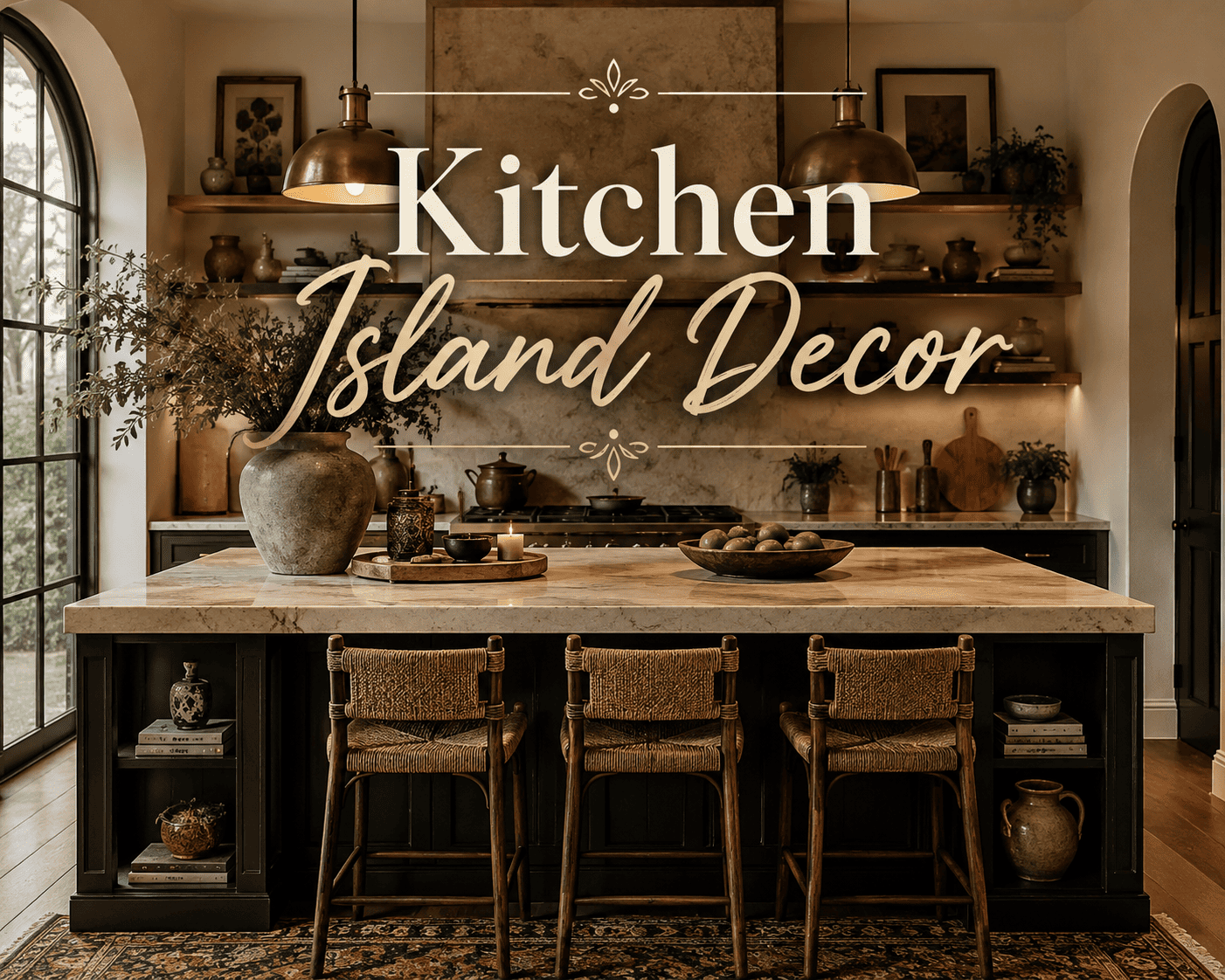
The easiest way to decorate a kitchen island is to start with one focal piece, then add one or two supporting elements with different heights, textures, or functions. A sculptural bowl, large ceramic vase, wooden cutting board, tray, greenery, or attractive serving piece can work beautifully.
The key is to avoid filling the entire countertop. Leave intentional negative space around your decor so the island remains practical and visually calm. For a modern kitchen, prioritize natural materials, simple shapes, restrained colors, and objects that serve a purpose whenever possible.
Introduction
The kitchen island has evolved far beyond a place to chop vegetables or leave a grocery bag. In many modern home decor, it is the visual center of the kitchen, a casual dining spot, a serving station, and often the first feature people notice when they walk into the room. That makes kitchen island decor more important than it might initially seem.
But styling an island well isn’t about covering the countertop with attractive objects. In fact, the most polished kitchens often use fewer pieces. What makes them look finished is the relationship between scale, height, texture, color, function, and empty space.
A beautiful vase can look awkward if it is too small for the island. A gorgeous tray can create clutter if it becomes a storage zone. Even expensive accessories can feel disconnected when they have nothing to do with the rest of the kitchen.
The secret is intentionality. Instead of asking, “What else can I put here?” ask, “What does this space actually need?”
These 18 modern kitchen island styling ideas reveal the small design decisions that can make an ordinary island feel collected, balanced, and surprisingly sophisticated—without sacrificing the workspace you use every day.
1. Let One Oversized Piece Do the Talking
One of the simplest ways to make a kitchen island look expensive is to stop trying to decorate every inch of it.
A single oversized vase, sculptural bowl, substantial ceramic vessel, or dramatic arrangement can create a stronger focal point than several tiny accessories scattered across the countertop. Large-scale decor gives the eye an obvious place to land and makes the styling feel deliberate.
Scale matters, though. A huge vase can overwhelm a narrow island, while a tiny bowl may disappear on a long countertop.
For a compact island, choose one medium-to-large statement piece. On a wide island, you can go more dramatic, especially if the rest of the kitchen has relatively simple cabinetry and finishes.
The goal isn’t simply “bigger is better.” The goal is proportionate impact.
2. Build a Three-Level Styling Story
If your island arrangement feels flat, the problem may not be the objects themselves. It may be their height.
Try combining three visual levels: something low, something medium, and something tall. For example, a wooden board can create the low layer, a ceramic bowl the middle layer, and a tall vase with branches the highest point.
Different heights create movement and prevent everything from appearing lined up like objects on a shelf.
You don’t need three separate accessories every time. A single arrangement can provide multiple levels naturally. Tall branches rising from a substantial vessel, for instance, already create vertical interest.
Keep the tallest element slightly off-center rather than placing everything in a rigid line. That small adjustment can make the composition feel much more natural.
3. Make the Fruit Bowl Look Architectural
A fruit bowl is one of the most useful pieces of kitchen island decor because it earns its countertop space. The trick is choosing one that looks intentional.
Instead of a basic plastic container, consider a sculptural stone bowl, hand-thrown ceramic piece, carved wooden bowl, or hammered metal design. Interesting curves and tactile surfaces can turn an everyday necessity into a decorative focal point.
Think about the relationship between the bowl and your countertop. A dark stone bowl can create beautiful contrast against a pale quartz island, while warm wood can soften a kitchen dominated by white, gray, and stainless steel.
Keep the contents relatively simple too. A bowl overflowing with every type of fruit can become visually busy. A restrained mix of citrus, apples, or seasonal produce usually looks more composed.
4. Bring in a Touch of Living Greenery
Modern kitchens can contain a lot of hard surfaces: stone countertops, cabinetry, glass, metal fixtures, and appliances. Greenery introduces an organic element that makes all those materials feel softer.
If your island sits near a sunny window, potted herbs such as basil, rosemary, or thyme can provide both visual interest and practical value. For a more decorative approach, use a vase filled with eucalyptus, olive branches, seasonal foliage, or another simple botanical arrangement.
You don’t need a collection of plants. One well-positioned plant or branch arrangement is often enough.
If your kitchen receives limited natural light, don’t force a plant into an unsuitable location. A high-quality artificial arrangement can provide the same visual effect without constantly struggling to keep a live plant healthy.
5. Use a Tray to Create a Decor Zone
A tray is one of the easiest tools for making kitchen island decor look organized.
Instead of having a candle, small bowl, salt container, and vase floating independently across the countertop, place a few related pieces on one tray. The tray visually groups them into a single composition.
Material matters. A wooden tray works beautifully in warm or rustic kitchens, while marble, metal, or sleek lacquered trays can complement contemporary spaces.
But don’t confuse containment with permission to add more stuff. A tray should create order, not become a miniature junk drawer.
A useful rule is to give each item a reason for being there. If the tray contains a vase, candle, and small bowl, each should contribute something different—height, warmth, texture, or function.
6. Style With Something Unexpected
A kitchen island becomes much more interesting when one element breaks the predictable pattern.
That might be a vintage vessel, a handmade ceramic object, a small sculptural piece, a stack of beautiful design books, or an item collected during travel. These objects introduce personality that mass-produced matching accessories often lack.
The unexpected piece doesn’t need to be expensive. What matters is that it feels connected to the people who live in the home.
For example, a weathered ceramic pitcher can add character to a farmhouse-inspired kitchen, while a geometric sculpture may feel more natural in a sleek contemporary space.
Think of it as the object that makes someone ask, “Where did you find that?”
7. Repeat a Color From Somewhere Else
One of the easiest designer tricks is repetition.
Look around your kitchen and identify an existing color worth echoing. It might be the green of the backsplash, the black of the window frames, the warm wood of the cabinetry, or the brass of the hardware.
Then repeat that color subtly in one or two island accessories.
You don’t need everything to match. In fact, exact matching can make a kitchen feel overly coordinated. Repeating a color creates a visual thread while allowing individual pieces to remain interesting.
For example, black pendant lights can be echoed through a dark ceramic bowl, while brass cabinet hardware might be subtly repeated in a small decorative vessel.
The connection is quiet, but the overall room feels more cohesive.
8. Add Warmth With Natural Materials
If your kitchen looks polished but slightly cold, texture may be the missing ingredient.
Natural materials such as wood, stone, rattan, woven fibers, and handmade ceramics add visual warmth without requiring a dramatic color change.
Imagine a white kitchen with a glossy countertop. A raw-edge wooden board, textured ceramic vessel, and woven tray can immediately introduce depth.
The best part is that these materials work across many design styles. Wood can feel Scandinavian, farmhouse, contemporary, or rustic depending on its shape and finish.
Instead of adding more color, sometimes adding texture is enough to make the island feel complete.
9. Turn Everyday Kitchenware Into Decor
Some of the best kitchen island accessories are things you already use.
A beautiful wooden cutting board leaning against the backsplash can become part of the composition. A ceramic pitcher can hold cooking utensils. A well-designed serving bowl can sit where it is both accessible and attractive.
This approach works particularly well for people who don’t want decorative objects taking over their countertop.
Choose functional pieces with attractive materials and silhouettes, then display only your best-looking essentials. You don’t need six cutting boards, three utensil containers, and every serving spoon on display.
The principle is simple: if an object has to live on the counter, make it beautiful enough to deserve the space.
10. Create a Moody Contrast
A modern kitchen decor
doesn’t always need to be bright, pale, and airy.
Dark accessories can create depth in kitchens dominated by white, cream, or light gray. Consider charcoal ceramics, black stone, aged bronze, dark wood, or deep green vessels.
The trick is moderation. A few darker elements can ground a pale island, while an entire collection of dark accessories may visually overwhelm the space.
For example, a creamy kitchen might need only one matte-black bowl and a dark wooden board to create contrast.
Think of these pieces as visual punctuation. They should strengthen the composition rather than dominate it.
11. Treat Pendant Lights as Part of the Styling
Kitchen island decor doesn’t stop at the countertop.
The pendant lights above the island are among the most visible elements in the room, so they should work with the objects beneath them rather than competing against them.
If your island has brass hardware, warm metallic pendant lights can reinforce that detail. If the kitchen uses black fixtures, black pendants can create a stronger visual frame.
Lighting also changes how your decor looks. Warm evening light can make wood, cream ceramics, and natural stone feel richer, while cooler lighting can emphasize crisp modern finishes.
Before adding accessories, look at the island during both daylight and evening hours. A composition that looks balanced in bright sunlight may need slightly different contrast at night.
12. Use Negative Space Like a Designer
This may be the most important secret on the entire list.
Empty space is not wasted space.
When every part of an island is covered with bowls, candles, plants, boards, and decorative objects, the eye has nowhere to rest. The result can feel cluttered even when every individual item is attractive.
After styling your island, deliberately remove one object.
Then step back.
If the arrangement suddenly feels cleaner, you’ve discovered the value of negative space.
This is especially important for islands used for food preparation. Leaving generous clear areas doesn’t just improve aesthetics; it keeps the kitchen functional.
A sophisticated island isn’t the one with the most decoration. It’s the one where every object has enough room to be appreciated.
13. Create a Seasonal Look Without Going Overboard
Seasonal kitchen island decor can keep your space feeling fresh, but it doesn’t need to become a themed display.
Instead of completely changing the island several times a year, make small adjustments. Replace fresh flowers with branches in autumn, switch a colorful bowl for a warmer ceramic piece, or introduce a subtle textile during the colder months.
This approach feels more sophisticated than filling the countertop with obvious seasonal decorations.
It also saves storage space. Your basic composition can remain the same while one or two details change throughout the year.
The result is seasonal without looking temporary.
14. Try a Monochromatic Styling Moment
Using one color family can create an incredibly polished island arrangement.
A white kitchen could use cream, ivory, and warm beige accessories. A darker kitchen could layer charcoal, black, and smoky gray. An earthy space might combine terracotta, clay, rust, and natural wood.
Because the colors are related, you can experiment more with texture and shape without creating visual chaos.
For example, three cream-colored ceramics won’t necessarily look boring if one is smooth, one is ribbed, and another has a handmade irregular surface.
The secret to monochromatic styling is variation within restraint.
Common Kitchen Island Decor Mistakes to Avoid
The most common mistake is over-accessorizing. Small decorative pieces tend to multiply quickly, especially on a large island, until useful counter space disappears.
Another problem is ignoring scale. Accessories that are too tiny can look lost, while oversized pieces can interfere with sightlines and function.
Avoid using too many unrelated colors and finishes as well. Your island decor doesn’t have to match perfectly, but it should have some visual relationship with the cabinets, hardware, backsplash, flooring, or lighting.
Finally, don’t decorate simply because an empty area feels “unfinished.” Sometimes that empty area is exactly what makes the rest of the styling work.
How to Style a Kitchen Island Without Making It Cluttered
Start with one focal point rather than several decorative objects.
Then add one functional piece, introduce a contrasting texture, vary the heights, and finally step back to evaluate the negative space.
A useful styling formula is:
One focal point → one functional element → one textural detail → varied heights → intentional empty space.
If the island still feels busy, remove something before adding anything else.
The goal is not to make the countertop look full. It’s to make it look considered.
FAQs
What should I put in the center of my kitchen island?
A sculptural bowl, large ceramic vase, natural branch arrangement, or substantial serving piece can work well as a centerpiece. Choose something proportional to the island and leave enough surrounding space for everyday use.
How do I make my kitchen island look expensive?
Prioritize scale, texture, and restraint. A few substantial pieces made from stone, wood, ceramic, or metal usually look more sophisticated than a large collection of inexpensive small accessories. Negative space is equally important.
How many decorative items should be on a kitchen island?
There is no universal number, but two to four thoughtfully grouped pieces are often enough. The ideal amount depends on the island’s size and function. A busy working island generally needs less decor than a large entertaining island.
What can I put on a kitchen island besides a fruit bowl?
Consider a sculptural vase, fresh greenery, wooden cutting boards, a decorative tray, handmade ceramics, a candle, attractive serving ware, or a functional utensil container. Choose pieces that add height, texture, function, or personality.
How do I decorate a kitchen island without losing counter space?
Concentrate decor in one defined area and keep the main preparation zone clear. Use vertical arrangements, compact trays, or one large focal piece instead of scattering many small objects across the countertop.
What decor looks best on a modern kitchen island?
Modern islands typically work well with sculptural ceramics, natural stone, simple wooden pieces, greenery, monochromatic accessories, and restrained metallic accents. The strongest combinations balance clean shapes with tactile materials.
Should kitchen island decor match the rest of the kitchen?
It should coordinate rather than match exactly. Repeating one color, material, or finish from the cabinets, backsplash, hardware, or lighting is enough to create a cohesive connection.
Conclusion
Great kitchen island decor isn’t about adding more. It’s about choosing better.
The most successful islands combine proportion, texture, function, contrast, and negative space to create a countertop that feels intentional without becoming precious or impractical.
Start with one piece that genuinely catches your eye. Add something useful, introduce a natural texture, vary the height, and then leave enough empty space for the arrangement to breathe.
Most importantly, let the island reflect the way you actually live. A kitchen should still be a kitchen—not a display shelf.
When every object earns its place and the empty space is treated as part of the design, even a simple kitchen island can become the feature that makes the entire room feel finished.

Leave a Reply