
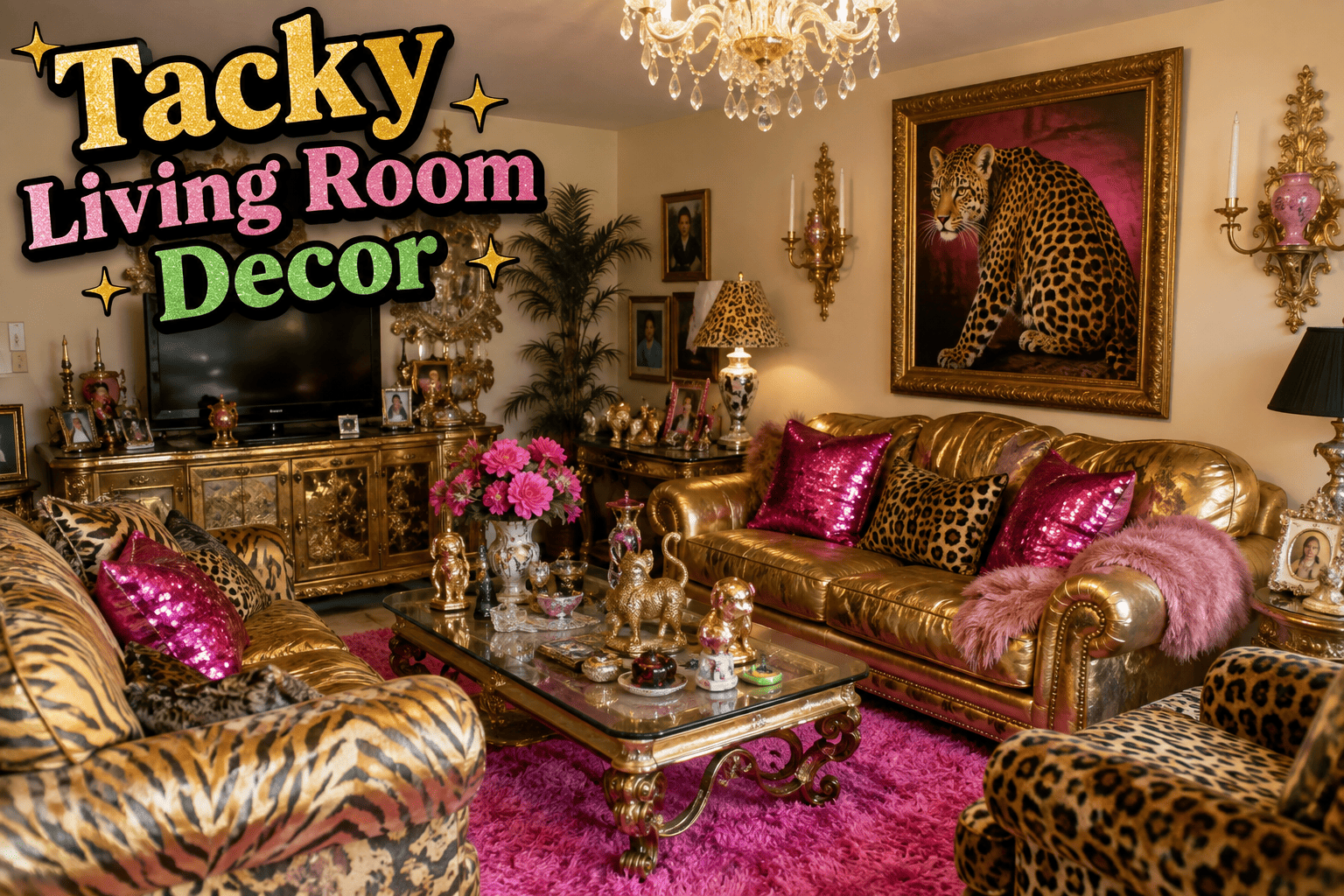
A living room usually looks tacky when decor becomes excessive, poorly proportioned, overly coordinated, or visually disconnected. Common problems include too much gold, cluttered surfaces, tiny rugs, oversized furniture, fake-looking materials, excessive trends, harsh lighting, and too many statement pieces. The easiest way to create a more elegant living room is to edit unnecessary decor, improve scale and balance, mix textures, and give standout pieces enough breathing room.
Introduction:
Have you ever walked into a living room filled with expensive furniture, glamorous accessories, and trendy finishes, yet something still feels strangely cheap? The problem is not always the price of the decor. In many cases, it is how everything is combined.
There is a fine line between luxurious, stylish, and overdone. A sophisticated living room does not necessarily contain the most expensive furniture or the largest collection of decorative accessories. Instead, it feels balanced, intentional, comfortable, and visually calm. Every piece has a purpose, and nothing has to fight for attention.
Tacky living room decor often happens when there is simply too much happening at once: too much shine, too many patterns, excessive matching, oversized furniture, artificial-looking accessories, or trends piled together without a clear design direction.
The good news? You do not need to replace your entire living room to make it look better. Sometimes, removing one unnecessary element or changing the scale of a few pieces can completely transform the space.
Here are 20 “stylish” choices that may secretly be making your living room look cheap—and the smarter ways to fix them.
1. The “Everything Must Match” Trap
Matching furniture may seem like the safest decorating choice, but a living room where the sofa, chairs, coffee table, curtains, cushions, and accessories all look like they were purchased together can feel more like a showroom than a real home.
A stylish space usually has some variation. You can keep a cohesive color palette while introducing different materials, shapes, and finishes. For example, a neutral sofa can work beautifully with a wooden coffee table, textured armchair, woven basket, and metal lighting fixture.
The goal is not to make everything identical. Coordination looks intentional; perfect matching can look predictable.
2. Gold Everywhere Is Not the Same as Luxury
Gold can instantly add warmth and glamour, but too much of it can have the opposite effect. Gold mirrors, gold lamps, gold tables, gold vases, gold frames, and gold hardware competing in the same room can quickly become overwhelming.
Instead of scattering metallic accents everywhere, choose one or two places where gold can make an impact. A simple gold-framed mirror or a subtle metallic lamp can be enough.
Luxury often comes from restraint. One beautiful metallic detail can feel far more sophisticated than an entire room covered in gold.
3. The Wallpaper Wall That Tries Too Hard
A feature wall can give a living room personality, but an extremely busy wallpaper pattern can dominate everything around it. When the wall has a dramatic print, bold colors, multiple accessories, and competing artwork, the room loses its visual hierarchy.
If your wallpaper is already expressive, let it be the star. Pair it with simpler furniture, quieter accessories, and a restrained color palette.
A statement wall decor should attract attention—not demand all of it.
4. Furniture That Looks Like It Came in One Box
A complete matching furniture set can make decorating easy, but it can also make the room feel generic. When every chair, table, cabinet, and sofa has the same finish and design language, there is little visual interest.
Try mixing complementary pieces instead. Combine a contemporary sofa with a vintage-inspired side table, or pair modern seating with natural wood furniture.
The trick is to create connection without repetition. Repeat one color, material, or shape across the room so the different pieces still feel related.
5. The Cushion Mountain
Throw pillows are an easy way to make a sofa look comfortable, but there is a point where cozy becomes cluttered.
If your sofa is buried under a dozen cushions, the furniture itself can disappear. Worse, if the pillows have completely different patterns and colors, they can make the room feel chaotic.
You do not need a huge collection. A handful of cushions in different sizes and complementary textures can create plenty of depth. Think linen, velvet, cotton, or woven fabrics rather than dozens of identical decorative pillows.
A stylish sofa should invite you to sit—not require you to move half the room first.
6. A Coffee Table With No Breathing Room
A coffee table covered with candles, trays, books, vases, figurines, and decorative objects may look impressive in a photograph, but in everyday life it can quickly become clutter.
Empty space is not wasted space. It gives the eye somewhere to rest and allows your favorite pieces to stand out.
Try grouping a few objects at different heights rather than covering the entire surface. A small stack of books, one decorative object, and a simple vase may be all you need.
The less crowded the surface, the more intentional the styling can feel.
7. Fake Marble That Looks Too Perfect
Marble-inspired finishes can bring an elegant look to a living room, but inexpensive materials with repetitive patterns, excessive shine, or obviously artificial veining can make the effect less convincing.
If real marble is outside your budget, you do not have to imitate it everywhere. Consider natural wood, textured stone-look surfaces, ceramic, or simple matte finishes instead.
Sophisticated decor does not have to pretend to be something it is not. Authentic-looking texture often feels more expensive than an exaggerated imitation.
8. The “Luxury” Mirror Overload
Mirrors can make a living room appear brighter and more spacious, but using too many decorative mirrors can create visual confusion.
Instead of placing a mirror on every available wall, choose one strong piece and give it room to breathe. A large mirror positioned thoughtfully opposite a window or light source can have much more impact than several small mirrors scattered around the room.
The frame matters too. Choose a style that complements the overall design rather than one that simply looks ornate.
9. Curtains That Fight With the Room
Curtains are often overlooked, yet they can dramatically influence how polished a living room feels. Curtains that are too short, excessively shiny, overly patterned, or poorly positioned can make an otherwise beautiful space look unfinished.
For a more refined appearance, floor-length curtains generally create a stronger sense of height. Choose a fabric that works with the room rather than competing with the sofa, rug, and walls.
Neutral or softly contrasting curtains can make the architecture and furniture feel more intentional.
10. The Giant Sofa Syndrome
An enormous sofa can look luxurious in a large showroom, but placing it inside a small living room decor can make the entire space feel cramped.
Furniture scale matters more than price. You need enough room for people to move comfortably around the seating area, and the sofa should relate proportionally to the walls, rug, coffee table, and other furniture.
Before buying a large sofa, measure the room and consider the walking paths. A beautifully proportioned medium-sized sofa can look much more luxurious than an oversized one squeezed into the wrong space.
11. Tiny Rugs That Make Everything Float
One of the easiest ways to make a living room look visually disconnected is choosing a rug that is too small.
When the rug sits like a tiny island underneath the coffee table while the sofa and chairs remain completely outside it, the seating arrangement can feel fragmented.
Whenever possible, choose a rug large enough to connect the major furniture pieces. Even having the front legs of the sofa and chairs resting on the rug can create a stronger visual relationship.
The rug should anchor the furniture, not simply decorate the floor.
12. Artwork Hung Like an Afterthought
Beautiful artwork cannot reach its full potential if it is placed at the wrong height or in the wrong proportion.
Artwork that is too small for a large wall can look lost, while an oversized piece above a small sofa can overwhelm the seating area. Placement matters just as much as the artwork itself.
Consider the furniture underneath it, the size of the wall, and the visual center of the room. A well-proportioned piece can make a simple living room feel dramatically more finished.
13. Artificial Greenery That Looks Obviously Fake
Plants can add life, softness, and color to a living room, but poor-quality artificial plants can have the opposite effect. Plastic-looking leaves, unnatural shine, and perfectly symmetrical arrangements often make them immediately noticeable.
If maintaining real plants is difficult, choose realistic faux greenery with varied textures and natural-looking shapes.
Better yet, select plants that suit the lighting conditions of your room. Even a simple real plant in an attractive pot can provide more character than a collection of obviously artificial greenery.
14. Too Many “Statement” Pieces
A statement chandelier, dramatic artwork, patterned rug, sculptural chair, colorful sofa, and oversized mirror may all be beautiful individually. Together, however, they can compete rather than complement one another.
A room needs visual hierarchy.
Choose one primary focal point and perhaps one secondary feature. Let the remaining decor support those elements instead of competing with them.
This is one of the easiest ways to make a living room feel more sophisticated: not everything needs to be the star.
15. Trend-Stacking Your Living Room
Following trends can be fun, but putting every popular style into one room rarely produces a timeless result.
Imagine combining boho macramé, farmhouse signs, glam mirrors, industrial furniture, coastal accessories, and ultra-modern lighting. Each style may look great separately, but without a connecting idea, the room can feel confused.
Instead, choose a dominant style and introduce trends selectively. A modern living room can borrow a vintage chair or a woven accessory without completely changing its identity.
Trends work best as accents, not as a substitute for personal style.
16. The Accent Color That Took Over
An accent color is supposed to add energy—not consume the entire room.
A rich green cushion or burgundy vase can create a sophisticated focal point. But when that same color appears on the walls, curtains, sofa, rug, artwork, and accessories, it loses its impact.
Use accent colors strategically. Repeat them in small doses across the room so they feel connected without becoming overwhelming.
A little repetition creates cohesion. Too much repetition creates visual fatigue.
17. Decorative Objects With Zero Personality
A living room can contain plenty of beautiful accessories and still feel completely soulless.
The problem is often buying objects simply because they look “fancy.” Generic sculptures, decorative boxes, oversized ornaments, and artificial luxury accessories do not necessarily tell the viewer anything about the people who live there.
Add objects with meaning instead. Display a piece collected during a trip, a favorite book, handmade pottery, family photography, or something connected to your interests.
The most memorable living rooms feel collected rather than manufactured.
18. Lighting That Makes Everything Look Worse
Even excellent furniture and beautiful decor can look disappointing under harsh lighting.
Cold white bulbs, excessive overhead lighting, exposed LED strips, or poorly positioned fixtures can flatten textures and make the room feel uncomfortable.
Layered lighting is a much better approach. Combine ceiling lighting with floor lamps, table lamps, or subtle accent lighting. This creates different levels of illumination and allows you to change the mood throughout the day.
Warm, comfortable lighting can make wood, textiles, artwork, and decorative finishes feel considerably more inviting.
19. Mixing Design Eras Without a Connecting Thread
Mixing styles is not automatically tacky. In fact, an eclectic living room can be incredibly sophisticated when the different elements feel intentionally connected.
The problem appears when every item belongs to a completely different visual world with no relationship between them.
You can mix modern and vintage furniture, for example, by repeating a shared color palette or material. A traditional wooden table can work beautifully with contemporary seating if another element connects them.
Eclectic style needs a visual thread. Without one, it simply looks random.
20. When More Decor Actually Makes the Room Look Cheaper
This may be the most important lesson of all: sometimes the best thing you can add to your living room is nothing.
When every shelf, wall, table, corner, and empty surface has been decorated, individual pieces lose their impact. The room becomes visually exhausting, and even expensive accessories can start looking cheap because there are simply too many of them.
Before buying something new, remove three things from the room and see what happens.
You may discover that the space instantly looks calmer.
Good interior design is not always about adding more. Sometimes it is about having the confidence to edit.
How to Make Tacky Living Room Decor Look Tasteful Without Replacing Everything
Mix Materials Instead of Matching Everything
Combine wood, fabric, metal, glass, stone, and woven textures to create depth. Different materials can make a room feel layered without requiring lots of color.
Choose One Hero Piece
Give the room a clear focal point. It could be a beautiful artwork, an unusual light fixture, a striking sofa, or a statement rug. Build the surrounding decor around it rather than competing with it.
Balance Budget Pieces With Timeless Elements
Not everything needs to be expensive. Affordable accessories can look excellent when combined with a few timeless, well-chosen pieces and thoughtful styling.
FAQ:
What are the biggest signs of tacky living room decor?
The most common signs include excessive clutter, too much matching furniture, poor furniture scale, excessive metallic finishes, fake-looking materials, harsh lighting, and too many competing focal points. A room can also feel tacky when it follows trends without developing a cohesive design direction.
Can expensive furniture still look tacky?
Absolutely. Price does not guarantee good design. Even expensive furniture can look awkward when it is too large, poorly placed, surrounded by clutter, or combined with unrelated styles. Proportion, balance, and styling often matter more than the price tag.
How do I make my living room look elegant instead of tacky?
Start by editing unnecessary decor and improving the room’s proportions. Then introduce layered textures, thoughtful lighting, a controlled color palette, and one or two strong focal points. Elegance usually comes from restraint rather than excess.
Final Thoughts:
The difference between a stylish living room and a tacky one is rarely about how much money was spent. It is usually about editing, proportion, balance, and intention.
You do not need to remove every glamorous accessory or avoid every trend. You simply need to know when a beautiful idea has been taken too far.
Let your furniture breathe. Give artwork enough space. Use metallics with restraint. Choose rugs and curtains that fit the room. Mix materials instead of matching everything. Most importantly, stop decorating simply for the sake of filling an empty space.
The most sophisticated living rooms are not necessarily the ones with the most impressive things. They are the ones where every piece feels like it belongs—and nothing is trying too hard to prove it.

Leave a Reply