
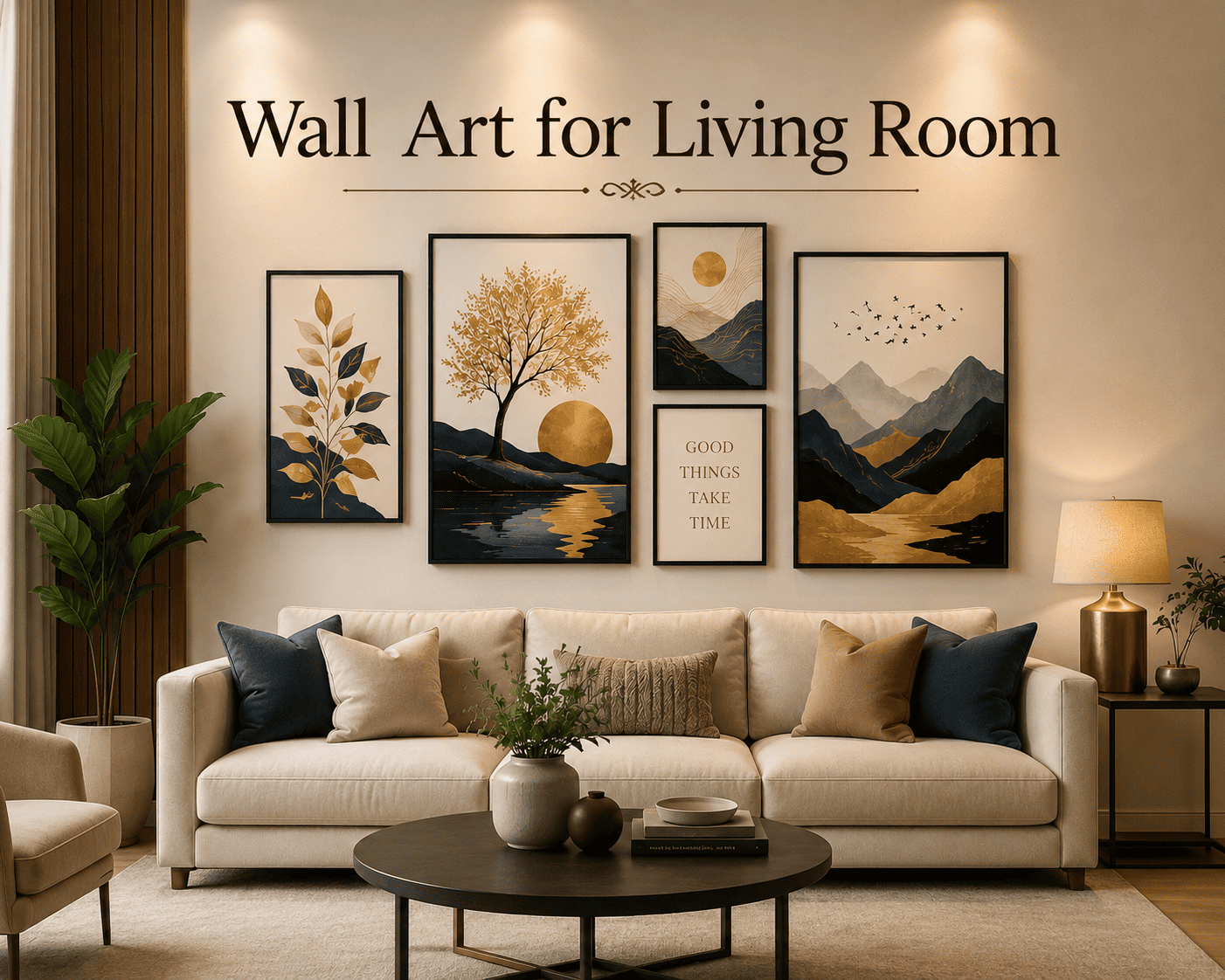
The best wall art for living room spaces should match the room’s scale, color palette, furniture, and overall mood. Oversized abstract art, textured canvas, gallery walls, framed photography, modern panels, and sculptural pieces can all transform an empty wall into a stylish focal point. For the best result, choose artwork that is large enough to relate to your furniture, hang it at a comfortable viewing height, and leave enough surrounding space for the design to breathe.
A living room can have a beautiful sofa, elegant lighting, a soft rug, and carefully selected accessories, yet still feel unfinished. The reason is often simple: the walls lack personality.
That is where the right living room wall decor can make a dramatic difference. Artwork can add color, texture, contrast, warmth, and character without requiring a complete room makeover.
But choosing wall art is not simply about finding a pretty picture. The size, frame, colors, placement, lighting, and relationship with your furniture all affect how the finished room looks.
Whether your style is modern, minimalist, luxurious, cozy, or artistic, these wall art ideas will help you turn a blank wall into a deliberate design feature.
1. Oversized Abstract Art for Instant Impact
When you have a large empty wall, one oversized abstract artwork can be more effective than several small pieces.
Large abstract art creates an immediate focal point while giving the room a sophisticated appearance. Look for compositions that include colors already present in your sofa, rug, curtains, or cushions.
Neutral abstracts work particularly well in contemporary interiors, while darker or richer artwork can give a simple room more drama.
The key is scale. Artwork that is too small can disappear against a large wall, while an oversized piece can anchor the entire seating area.
2. Create a Statement Wall Behind the Sofa
The wall behind the sofa is one of the easiest places to introduce statement wall art because the furniture naturally creates an anchor.
Instead of decorating every inch of the wall, choose one dominant artwork or a carefully arranged group.
The artwork should visually relate to the sofa rather than appearing disconnected from it. A wide horizontal canvas works particularly well because its shape naturally follows the width of the seating area.
For a more dramatic look, choose artwork with strong contrast against the wall color.
3. Try a Three-Panel Artwork Set
A triptych, or three-panel artwork arrangement, offers the visual impact of large artwork while creating more movement across the wall.
Three related panels can feature an abstract design, landscape, botanical imagery, geometric forms, or a continuous picture divided across separate canvases.
This style works particularly well above a long sofa because it fills horizontal space without looking like one oversized block.
Keep the spacing between the panels consistent so the arrangement feels intentional.
4. Add Texture With Canvas Wall Art
If your living room already has plenty of color, consider adding texture instead.
Textured canvas artwork can introduce depth through raised surfaces, brush marks, layered materials, or subtle patterns. This is especially effective in neutral rooms where color contrast is limited.
Cream, beige, taupe, white, and soft gray textured art can create a refined look without overwhelming the space.
Texture also works beautifully with natural wood, linen furniture, boucle seating, and other tactile materials.
5. Use Black-and-White Photography
Black-and-white photography is a timeless option for modern living room wall decor.
Architectural photographs, portraits, city scenes, landscapes, and artistic compositions can all work depending on the personality of the room.
The limited color palette makes black-and-white art easy to coordinate with many interiors.
For a polished contemporary appearance, use simple black frames and consistent spacing. For a softer look, combine monochrome photographs with warm wood frames.
6. Build a Curated Gallery Wall
A gallery wall gives you more freedom to combine different forms of artwork.
Instead of buying random prints, create a visual connection between the pieces. You might use a shared color palette, matching frames, similar subjects, or a consistent artistic style.
A gallery wall can include paintings, photographs, line drawings, typography, botanical prints, or small decorative objects.
Before hanging anything, arrange the pieces on the floor and experiment with different layouts. This makes it easier to find a balanced composition without creating unnecessary holes in the wall.
7. Choose Minimalist Line Art
For a clean and contemporary interior, minimalist line art can add personality without creating visual clutter.
Simple faces, figures, botanical outlines, and abstract continuous-line drawings work especially well with white, beige, gray, and natural-toned interiors.
The beauty of line art is its restraint. It gives the wall character while preserving the calm feeling of a minimalist room.
Choose a larger print or combine several related pieces if your wall is wide.
8. Bring Nature Indoors With Botanical Art
Botanical artwork can make a living room feel fresher and more connected to nature.
Instead of traditional floral paintings, consider modern botanical prints, oversized leaf illustrations, pressed-flower-inspired artwork, or artistic plant photography.
Green artwork works particularly well with natural wood, cream, tan, terracotta, and earthy interiors.
If your room already contains real plants, botanical artwork can reinforce the natural theme without making the decor feel overly coordinated.
9. Make Luxury Wall Decor Look Effortless
Luxury wall decor does not need to be loud.
One refined artwork with an elegant frame can often create more sophistication than an entire wall filled with decorative objects.
Look for subtle metallic details, rich neutral colors, high-quality framing, layered textures, or sophisticated abstract compositions.
Black, ivory, charcoal, bronze, champagne, and muted gold can create a luxurious atmosphere without making the room feel excessive.
The secret is restraint. Let one beautiful piece become the star.
10. Add Sculptural Wall Decor
Wall art does not have to be flat.
Sculptural wall decor can introduce shadows, dimension, and architectural interest. Organic metal shapes, carved wood, textured plaster pieces, and dimensional abstract designs can make a plain wall feel more visually sophisticated.
This approach is particularly effective when your furniture is simple and your walls need more depth rather than more color.
Position sculptural pieces where natural or artificial light can create subtle shadows throughout the day.
11. Use a Large Mirror as Artistic Decor
Although a mirror is not traditional artwork, it can perform a similar visual role.
A large decorative mirror can reflect natural light, make a room feel more open, and act as a strong focal point.
Choose an unusual shape or distinctive frame if you want the mirror to function as a design statement.
Arched, irregular, round, and oversized mirrors can create a more contemporary appearance than standard rectangular designs.
This is especially useful in smaller living rooms where traditional artwork may not provide the sense of openness you want.
12. Experiment With Modern Geometric Art
Geometric artwork is ideal for contemporary living rooms.
Circles, arches, blocks, lines, grids, and overlapping shapes can introduce structure without relying on realistic imagery.
Choose colors that complement your interior rather than competing with it.
For example, a neutral room can benefit from artwork featuring warm terracotta, muted green, charcoal, or deep blue. If your furniture is already colorful, a neutral geometric composition may provide better balance.
13. Create a Moody Focal Point
If your living room feels too bright or predictable, darker artwork can create a dramatic focal point.
Deep navy, charcoal, forest green, burgundy, and black artwork can add visual depth while giving the room a more sophisticated personality.
Dark artwork is especially effective against light walls because the contrast immediately draws attention.
However, balance the darkness with lighter furniture, warm lighting, or natural textures so the room still feels inviting.
14. Use a Wide Landscape to Add Calm
Landscape artwork can make a living room feel peaceful and spacious.
A wide image of mountains, water, countryside, desert scenery, or an atmospheric sky can visually extend the wall and introduce a sense of openness.
Choose artwork with a color palette that complements the room.
Soft landscapes are particularly useful when you want your living room to feel relaxing rather than dramatic.
15. Style a Small Wall With a Vertical Artwork
Not every wall requires a horizontal piece.
A narrow vertical artwork can work beautifully beside a doorway, fireplace, cabinet, reading chair, or tall piece of furniture.
Vertical art draws the eye upward and can make a wall feel taller.
This is a useful solution for awkward spaces where a wide artwork would feel cramped.
16. Match Artwork to the Room’s Color Story
One of the easiest ways to make wall art feel intentional is to connect it to your existing color palette.
You do not need an exact color match. Instead, choose artwork that repeats one or two tones already visible in the room.
For example, artwork containing muted blue can connect with cushions or curtains, while earthy artwork can reinforce wooden furniture and natural textiles.
This creates cohesion without making the room look overly coordinated.
17. Light Your Artwork Like a Gallery
Even excellent artwork can lose its impact when it is poorly lit.
Natural daylight can reveal colors and textures during the day, while directional lighting can highlight the artwork after sunset.
Picture lights, adjustable wall lights, or carefully positioned ceiling fixtures can all help.
Avoid harsh glare, especially when artwork is behind glass or has a glossy finish.
Think of lighting as part of the artwork’s presentation rather than an afterthought.
18. Leave Some Wall Space Empty
One of the most underrated wall art ideas is knowing when to stop.
A beautifully decorated wall needs breathing room.
If you place artwork, shelves, mirrors, plants, frames, and accessories everywhere, the eye has nowhere to rest. The result can feel cluttered rather than luxurious.
Negative space allows your favorite artwork to become more noticeable.
A single oversized piece surrounded by clean wall space can often look more expensive and sophisticated than a crowded arrangement.
How Big Should Wall Art Be Above a Sofa?
Scale is one of the most important rules in living room decor.
As a general guideline, artwork or a group of artworks above a sofa should cover roughly two-thirds to three-quarters of the sofa’s width. This creates a visual relationship between the furniture and the wall without making the artwork feel oversized.
For example, if your sofa is approximately 84 inches wide, artwork in the range of roughly 56 to 63 inches wide can provide a useful starting point.
The exact measurement can vary depending on the design, but the principle remains the same: large furniture usually needs artwork with enough visual weight to balance it.
Before purchasing, mark the proposed dimensions on your wall with painter’s tape. Step back and view the arrangement from different parts of the room.
This simple trick can save you from choosing artwork that looks perfect online but feels too small once it reaches your wall.
How High Should Living Room Wall Art Be Hung?
Artwork should feel connected to the furniture beneath it.
When hanging artwork above a sofa or console, avoid placing it so high that it appears to float independently on the wall.
A comfortable viewing height usually works better, but furniture placement should influence the final position. The artwork should visually bridge the gap between the wall and the furniture.
Always step back after installation. Looking at the entire wall from several feet away is more useful than judging the placement while standing directly underneath it.
Should Wall Art Match the Sofa?
It does not have to match the sofa exactly.
In fact, exact matching can make a room feel overly planned.
Instead, look for a visual relationship. Artwork can repeat a color from the sofa, contrast with it, complement its texture, or introduce a new accent color that appears elsewhere in the room.
For a neutral sofa, artwork can provide the main color statement. For a colorful sofa, more restrained artwork may create better balance.
The goal is coordination, not duplication.
How to Make a Large Blank Wall Look Expensive
A large wall does not necessarily need expensive artwork.
The biggest difference often comes from scale and presentation.
Choose artwork that is appropriately sized, use a frame that complements your interior, position it carefully, and provide sufficient lighting.
A large, simple artwork with excellent proportions can look more luxurious than a collection of expensive but undersized pieces.
The wall should feel curated rather than filled.
Common Wall Art Mistakes to Avoid
Choosing artwork that is too small is one of the most common problems. Small pieces can disappear against large walls and furniture.
Another mistake is hanging artwork too high. When the relationship between the artwork and sofa becomes disconnected, the entire arrangement can feel awkward.
Using too many competing statement pieces is another issue. If every item demands attention, nothing becomes a true focal point.
Finally, avoid choosing artwork purely because it is trendy. Your living room should reflect your personality, not simply reproduce the latest showroom look.
Frequently Asked Questions About Wall Art for Living Room
What type of wall art looks best in a living room?
Oversized abstract artwork, textured canvas, photography, gallery walls, botanical prints, geometric art, and sculptural wall decor can all work beautifully. The best choice depends on your room’s size, color palette, furniture, and personal style.
What size should wall art be above a sofa?
A useful starting point is artwork measuring around two-thirds to three-quarters of the sofa’s width. This generally creates a balanced relationship between the artwork and furniture.
Should living room wall art match the decor?
It should coordinate with the decor rather than match everything exactly. Repeating one or two existing colors or introducing a complementary accent can create a cohesive appearance.
Is one large piece better than a gallery wall?
Neither is universally better. One large artwork creates a clean, dramatic focal point, while a gallery wall provides more personality and flexibility. Choose based on your wall size and preferred style.
How do I decorate a very large blank living room wall?
Consider oversized artwork, a multi-panel piece, a curated gallery wall, sculptural decor, or a large mirror. The most important factor is choosing something with enough visual scale to relate to the size of the wall.
Final Thoughts
The right wall art for living room spaces does more than cover an empty wall. It establishes a focal point, connects your furniture, introduces personality, and influences the atmosphere of the entire room.
Start with your room rather than the artwork. Consider the wall size, sofa width, existing colors, furniture style, natural light, and overall mood. Then choose a piece that adds something the room currently lacks.
An oversized abstract canvas can create drama. Textured art can add warmth. Photography can bring timeless character. A gallery wall can tell a personal story. Sculptural decor can introduce dimension.
And sometimes, the most sophisticated decision is simply to display one exceptional piece and leave the rest of the wall alone.
Your living room does not need more decoration just to look finished.
It needs the right visual statement.
Choose artwork that feels personal, give it the right scale and placement, and your blank wall can become one of the most memorable parts of your home.

Leave a Reply